Buy Monero without KYC: Haveno, atomic swaps and P2P
Published 22 Oct 2026
How to buy Monero without KYC: Haveno and other P2P markets, atomic swaps and instant swaps, compared on fees, limits and what each one learns about you.
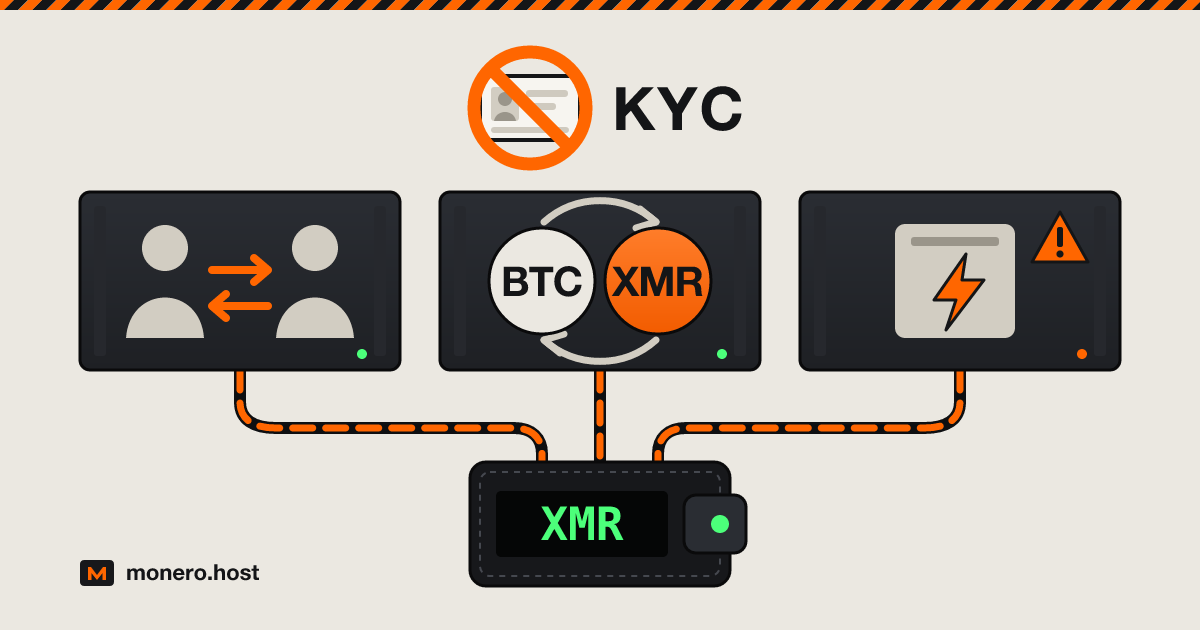
You can still buy Monero without KYC, just not on the big exchanges. The routes that work are peer-to-peer markets such as Haveno, atomic swaps from Bitcoin, instant swap services and simply getting paid in XMR, and they differ less on price than on what the other side learns about you. This guide compares them on speed, fees, limits and exposure, then walks through paying a hosting invoice with the coins.
Checked on 1 October 2026.
Why most exchanges stopped listing Monero
Monero hides the sender, the receiver and the amount of every transaction by default. Regulated exchanges have to know who sends what to whom, so they keep dropping it:
- OKX suspended XMR deposits on 27 December 2023 and delisted its XMR pairs on 5 January 2024.
- Binance stopped XMR trading on 20 February 2024 and ended withdrawals on 20 May 2024.
- Kraken halted Monero trading and deposits for clients in the European Economic Area on 31 October 2024, citing regulatory changes.
In the EU the next step is already law. From 10 July 2027, Article 79 of the Anti-Money Laundering Regulation (EU) 2024/1624 prohibits crypto-asset service providers from keeping any account that allows the anonymisation of transactions, "including through anonymity-enhancing coins".
LocalMonero, a marketplace that had run for nearly seven years, wound down in 2024. If you are looking for a LocalMonero alternative, the answer today is software rather than a website: you run it yourself, and no company holds your coins in between.
First, a wallet you control
Every route ends with XMR landing in a wallet, so set one up first and make sure you are the only one holding its seed. Haveno and eigenwallet have wallets built in; a swap service or a client pays to an address you give. Never leave a balance with a service that holds the keys.
- Feather (Linux, Tails, Windows, macOS): open source, small and fast, and it broadcasts transactions over Tor by default. The Feather wallet runs on desktops only, so it suits a laptop.
- Cake Wallet (iOS and Android, with Linux and Windows builds): open source, and the phone option in this list.
- Monero GUI and CLI: the official wallets for Windows, macOS and Linux, the CLI for more platforms.
Feather's documentation notes that a remote node cannot see your addresses or touch your funds, but over clearnet it can tie your outgoing transactions to your IP. Running your own Monero node takes it out of the picture.
Write the seed on paper and keep it offline. Then give every counterparty its own subaddress (they start with an 8), so the people who pay you cannot link their payments to one wallet. In the command-line wallet:
address new from-swap-1
Four ways to get Monero without KYC
Where to buy Monero now depends mostly on what you already hold: money in a bank account, Bitcoin, or skills someone will pay for.
Peer-to-peer markets: Haveno networks and Bisq
Haveno is open-source exchange software (AGPL-3.0), built on Bisq's code, that trades Monero against fiat and other coins over Tor. Trades settle through a Monero multisig escrow: an arbitrator settles disputes but never has access to your funds.
The Haveno project runs no trading network of its own and endorses none, so you install the build of a third-party network. RetoSwap is one. On 1 October 2026 its site lists a 0.1% maker fee, a taker fee of 0.8% on crypto trades or 2% on fiat trades, and payment methods from SEPA and ACH transfers to cash sent by mail. It verifies no identities, since it is only software.
- Deposits are in XMR. Both sides normally lock a security deposit (at least 15% of the trade in RetoSwap's code), returned when the trade completes. If you hold no XMR yet, look for no-deposit offers: the seller gives you a passphrase and you take the offer without a deposit.
- Your payment method is your exposure. RetoSwap says your payment account details stay on your machine and go only to your trade partner, but a bank transfer still shows that partner the name on your account. Cash sent by mail need not carry your name, though you then trust the post.
Bisq, the older sibling, trades Bitcoin against other assets, XMR included, so you need Bitcoin first. On 1 October 2026 its wiki lists fees of 0.15% for the maker and 1.15% for the taker when paid in BTC, a security deposit of at least 15% and a one-day trade period for altcoin trades.
Bitcoin to Monero atomic swaps
If you already hold Bitcoin, an atomic swap is the cleanest BTC to XMR route: either the swap completes or each side gets its own coins back, and no one holds the funds in between.
- eigenwallet, formerly UnstoppableSwap (GPL-3.0; Linux, macOS, Windows; everything over Tor), swaps Bitcoin for Monero, in that direction only. Its docs put the usual minimum at 0.0003 BTC and say the Bitcoin lock takes around 10 minutes to confirm, with the Monero lock about 2 minutes later. A stalled swap can be cancelled after 24 Bitcoin confirmations (about 4 hours), and you then have about 24 hours to take your refund, which the app does if it runs for a few minutes in that window. Miss the window and the maker can claim your Bitcoin. Some makers also hold back a small anti-spam deposit, usually paid out after a further timelock.
- BasicSwap (MIT) swaps in both directions between Bitcoin, Monero, Litecoin and other coins, with no trading fee. It runs each coin's official core wallet, so setup is heavier, and its own docs say the Tor integration is experimental and should not yet be relied upon.
What the maker learns is your Bitcoin transaction, which is public. If those coins came from an exchange that knows you, the swap sits one hop from your name.
Instant swap services, and why they can freeze funds
You send coins to a service and it sends XMR back: no account, a few minutes when all goes well. A wallet's built-in exchange button can be one too: Cake Wallet's docs say third-party providers carry out its swaps.
The catch is custody. Between deposit and payout, the coins are in the service's hands. The terms of two large services we read let them hold or freeze a deposit their risk checks flag, ask for documents or refuse the swap. "No KYC" then lasts until your coins are flagged, sometimes for a history you knew nothing about.
A service can also disappear with your swap inside it. On 30 April 2025, Germany's Federal Criminal Police Office and Frankfurt prosecutors took offline a swap service that had run since 2014 and seized about €34 million in crypto held by it (BKA press release). It had advertised that it applied no anti-money-laundering checks. If you use one, keep amounts small, send coins whose history you know, and receive to a fresh subaddress.
Being paid in Monero for work or goods
The oldest route: invoice in XMR for freelance work, things you sell or tips on a project. No market, no deposit, no swap, and the payer learns only what you tell them. Give each payer a fresh subaddress and keep records: the IRS, for one, counts it as income at its dollar value on the day you receive it.
Comparison table: speed, fees, limits, what the other side learns
Figures are those published by each project on 1 October 2026.
| Route | Speed | Cost | Limits | What the other side learns |
|---|---|---|---|---|
| Haveno, fiat (RetoSwap) | Up to a week, by payment method | 0.1% maker, 2% taker, refundable XMR deposit | Per offer; no-deposit offers for a first buy | What your payment method carries, such as your bank account name |
| Haveno, crypto (RetoSwap) | Minutes | 0.1% maker, 0.8% taker | Per offer | Your transaction on the other chain |
| Bisq (BTC to XMR) | Trade period of one day | 0.15% maker, 1.15% taker in BTC, deposit from 15% | You need BTC first | Your Bitcoin transactions |
| eigenwallet atomic swap | About 12 minutes until both sides are locked | Maker's markup plus the Bitcoin fee | Usually from 0.0003 BTC, maximum per maker | Your Bitcoin transaction, over Tor |
| BasicSwap atomic swap | Both chains' confirmation times | Network fees only | Per offer | Your coin transactions, and your IP unless you route it through Tor |
| Instant swap service | Minutes, unless flagged | A spread built into the quoted rate | Set by the service, and a flagged deposit can be held | Your IP unless you use Tor, both addresses, documents if flagged |
| Paid for work | When the client pays | None | None | What you tell the client |
Add about 20 minutes to every row before the coins are spendable.
Legal and tax basics (not advice)
This is a factual summary, not legal or tax advice. Rules differ by country and change.
- EU. The 2027 rule binds crypto-asset service providers, not your own wallet. Recital 160 of the same regulation says the prohibition does not apply to providers of self-hosted wallets that have no access to or control over them.
- US. FinCEN's 2019 guidance (FIN-2019-G001) puts the duties on businesses: a money transmitter dealing in anonymity-enhanced coins has the same obligations as with any other currency, while someone who obtains virtual currency to buy goods or services for themselves is a user, not a money services business. Selling Monero to others as a business can bring you under those rules.
- US tax. The IRS treats digital assets as property. You answer "Yes" to the digital asset question on Form 1040 if you received coins as payment, swapped one coin for another (Bitcoin for Monero included), or spent coins on goods or services, a hosting invoice included. Buying with dollars and holding means "No".
- Everywhere. Keep a record of each trade: date, amount, price and the route you used.
From wallet to invoice: paying a hosting provider in Monero
- Wait for the unlock. Monero adds a block about every 2 minutes, and every output you receive stays locked for 10 blocks, so allow roughly 20 minutes before new coins are spendable.
- Read the checkout before you order. Our VPS bay, RDP bay and domain bay show which providers take XMR directly, and their checkouts differ. SporeStack needs no email: you top up a balance held on a token, and its home page talks of a $100 deposit. Mynymbox and BTCVPS run their own payment gateways and ask only for an email address. Cockbox provisions the server after one confirmation.
- Send the exact amount to the invoice address. Copy both, never retype them. Your wallet adds the network fee on top. If the invoice shows a deadline, pay before it: Cockbox, for example, gives the payment three days to confirm and turns any overpayment into extra service time.
- Keep the proof. If an invoice does not register, the transaction key proves the payment: the provider checks it with
check_tx_keyagainst the transaction ID and its own address. - Mind your change. The change from a payment is locked for 10 blocks as well, so two invoices paid back to back can mean a 20-minute wait between them.
In the command-line wallet:
balance
transfer <invoice address> <exact amount>
get_tx_key <txid>
To order over Tor and log in with fresh keys, follow our step-by-step VPS and RDP guide. To pick a provider, start with our list of hosting providers that accept Monero. If a domain comes next, see our guide to anonymous domain registration.
FAQ
Can I buy Monero without KYC?
Yes. Haveno networks, Bisq, atomic swaps and being paid in XMR all work without identity documents. What has gone is the big exchanges: OKX, Binance and Kraken in Europe dropped it, and regulated ones that still list it check ID.
Is it possible to buy Monero anonymously?
Privately, yes. Fully anonymously takes care, because the weak point is the other currency: a bank transfer shows your name to the seller, and the Bitcoin you swap has a public history. Once the XMR is in your wallet, the amounts and addresses of your transactions are hidden on chain. Use tools that run over Tor and a fresh subaddress for each trade.
Can US citizens buy Monero?
Yes. At federal level the obligations fall on businesses that transmit it, not on people who buy it for their own use. Peer-to-peer networks and atomic swaps work from the US, and gains are taxable like any other property.
Is Monero illegal in the US?
No, not at federal level as of October 2026. FinCEN treats businesses that handle it like any money transmitter, and the IRS taxes it as property. State rules can add requirements, and this is not legal advice.
Why is Monero getting banned?
It is being removed from regulated platforms rather than banned for individuals. Exchanges must identify who sends funds to whom, and Monero hides that by design. The EU makes it explicit: from 10 July 2027, crypto-asset service providers may not keep accounts that allow anonymisation through coins like Monero.
What's the easiest way to buy Monero?
If you hold Bitcoin, an atomic swap in eigenwallet: pick a maker, send the Bitcoin, and the Monero lock follows within minutes. If you start from a bank account, a Haveno network such as RetoSwap, with a no-deposit offer for your first purchase.
How to buy Monero without KYC, in short
A wallet you control before anything else. Peer-to-peer for fiat, atomic swaps for Bitcoin, instant swaps only for amounts you could live with seeing frozen. Then wait ten blocks, pay the exact amount, and keep the transaction key.