Anonymous domain registration: WHOIS privacy and Monero
Published 1 Oct 2026
Anonymous domain registration explained: what WHOIS privacy hides, what your registrar still knows, and which registrars let you pay in Monero.
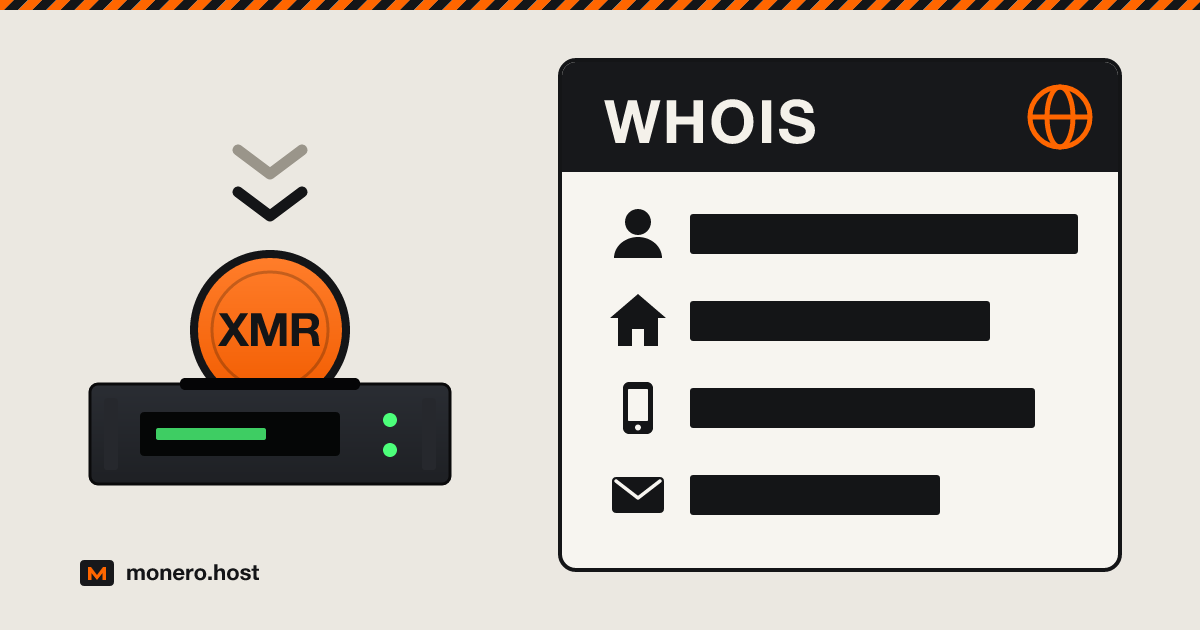
Anonymous domain registration is possible, but not through the WHOIS privacy checkbox most registrars offer. That box hides your name from the public record while the registrar keeps it on file, with your email or phone verified and the whole record open to disclosure requests. To register a domain anonymously you need a company that holds the name for you, or a registrar that never learns who you are, and a payment that carries no identity: Monero.
Checked on 1 October 2026.
What registering a domain reveals about you
Generic domains (.com, .net, .org and the newer extensions) are sold under contracts with ICANN. The 2013 Registrar Accreditation Agreement requires the registrant to give a full name, postal address, email address and phone number, and to keep them accurate. Within 15 days the registrar must verify the email or the phone with a code you send back; without an answer, it checks by hand or suspends the domain. Knowingly false details are grounds for suspension or cancellation.
What the public sees is a separate question. Since 28 January 2025 RDAP has replaced the old WHOIS protocol as the official lookup service, and since 21 August 2025 ICANN's Registration Data Policy sets what it shows. A registrar must redact personal data where the law requires it and may choose to redact it elsewhere. Redacted, your name, street, postal code and phone disappear and your email becomes a web form or relay address. Your country, and your state or province if collected, are still published.
You can read a .com's public record with one request to the registry:
curl -s https://rdap.verisign.com/com/v1/domain/example.com
Replace example.com with the name you want to look up. For a domain held at a registrar, a related link in the answer points to that registrar's own RDAP server, which holds the contact data.
Behind the redaction, the data stays one request away. The same policy gives registrars two business days to acknowledge a disclosure request and 30 days to answer it. ICANN's Registration Data Request Service, open since 28 November 2023 and extended after its pilot ended in November 2025, lets law enforcement, intellectual property professionals, security specialists and others with a legitimate interest send such requests to participating registrars, which decide whether to disclose.
Redaction also does nothing about the other trails: the card you paid with, the email on your account, the IP address you ordered from.
Three levels of domain privacy
WHOIS privacy: your data is redacted, not gone
Most registrars sell this, or now include it: redaction, or a privacy service whose details replace yours in the record. You are still the registrant, and the registrar still holds your name, address and phone number. WHOIS privacy protection keeps spam and casual lookups away. It is not anonymity.
A proxy registrant that holds the domain for you
Here a company registers the domain in its own name and gives you the right to use it. Njalla works this way: its terms say domains are registered under Njalla's name, that ownership vests in you, and that you can ask for a formal transfer at any time. It is run by Njalla SRL in Costa Rica and asks only for an email or XMPP address. Mynymbox (a Nevis company), NiceVPS (under the law of Dominica) and IncogNET offer the same kind of private domain registration.
The catch sits in section 3.7.7.3 of the ICANN agreement. A registrant that lets someone else use a domain must reveal that user within seven days to anyone showing reasonable evidence of actionable harm, or accept liability itself. A proxy registrant can only reveal what it holds.
A registrar that never learns who you are
The strongest setup is a proxy registrant that knows almost nothing about you: an address used nowhere else, payment in Monero, orders placed over Tor. Njalla's terms say it collects only your email or XMPP address and password, and may pass that to authorities if you break its usage rules. Mynymbox writes that a lawful order can only produce what it actually holds.
This protects people with lawful reasons to stay unnamed: critics, activists, anyone who has been harassed. It does not stop a registrar from suspending a domain used for abuse: Njalla's terms and Mynymbox's domain page both reserve that right.
Is WHOIS privacy worth it?
For an ordinary site, domain privacy is worth it whenever it is free, and at 1984 Hosting, FlokiNET and OrangeWebsite it is included. Where a registrar does not redact, your name, street, phone and email sit in a public record that scrapers copy, and a record that was public once can live on in commercial WHOIS history archives. Turn it on before the first registration.
It does not hide you from your registrar, from a valid legal order, or from your payment trail. For that you need one of the other two levels.
Extensions that make anonymity harder
ICANN's rules cover generic domains. Country codes follow their own registry, and some close the door on privacy. This summarises published registry policies and is not legal advice.
- .us: registrants must be US citizens or residents, US organisations, or foreign entities with a bona fide presence in the United States. The usTLD privacy policy bans anonymous and proxy registration, and registrars may not put their own details in place of yours.
- .eu: only citizens of an EU country, Iceland, Liechtenstein or Norway, residents of those countries, and organisations established there may register, and EURid can verify your registration data at any time.
- Other ccTLDs: several require a local presence or contact. Mynymbox, for one, does not sell those it cannot hold in its own name.
If privacy is the point, pick a generic extension (.com, .net, .org, .xyz) or a country code your registrar can hold for you.
How to buy a domain with Monero, step by step
- Get Monero. If you hold none, the no-KYC routes are in step 1 of our guide to renting a server without KYC. A .com costs €14 to €19 at the registrars below, so a small amount does.
- Open a clean connection. Tor Browser, or a VPN paid in Monero. Use the registrar's onion address where it has one.
- Create a dedicated contact. A new email address, or XMPP for Njalla, used for nothing else. NiceVPS needs no email at all.
- Check the extension's rules before you search.
- Choose Monero at checkout. The invoice shows an address and an exact amount. Pay from your own wallet, not an exchange account. Monero adds a block about every two minutes, and the invoice settles after a few confirmations.
- Wait for activation. NiceVPS delivers automatically. IncogNET activates .st instantly and approves other extensions by hand, which can take 12 hours or more.
- Secure the account. A unique password, two-factor authentication where offered, the renewal date in your calendar. With a proxy registrant the account is your proof of control, so back up its credentials.
An expired domain can be registered by anyone. Renew early, or pay for several years at once.
Registrars for anonymous domain registration that take Monero
Each row was checked on the provider's own pages on 1 October 2026: Monero offered for domains and not only for servers, what the order form asks, whether an onion mirror is published, and the first-year price of a .com. Alphabetical order. Prices change, so confirm before you pay.
| Registrar | Privacy model | Signup asks | Onion | .com, year 1 |
|---|---|---|---|---|
| 1984 Hosting | Domain privacy, where the TLD allows | Email, phone optional; its terms record name, phone and payment details | None listed | €13.99 |
| FlokiNET | ID Protection, free | Email per its site; checkout also shows name, address and phone fields | Yes | €18.75 |
| IncogNET | Held under IncogNET's details | Yes | $17.76 | |
| Mynymbox | Held by Mynymbox Hosting LLC | Email, alias accepted | Yes | €15.00 |
| NiceVPS | Held in NiceVPS's name | Username and password, email optional | Yes | €15.99 |
| Njalla | Held in Njalla's name | Email or XMPP | Yes | €15.00 |
| OrangeWebsite | Private WHOIS, included | None listed | €18.90 |
What the table does not show:
- Renewals can cost more. NiceVPS renews a .com at €29.99, Mynymbox at €16.
- Monero takes different routes. IncogNET, Mynymbox and NiceVPS process crypto themselves. OrangeWebsite uses NOWPayments, a third-party processor. Njalla takes it as a wallet top-up that then pays for domains. 1984 Hosting prices every domain in XMR but offers no crypto to customers who appear to be in Iceland.
- Two are missing on purpose. Cinfu and SuperBitHost also sell domains, but on the day of this check we could not confirm Monero at their domain checkout. Cinfu's terms also require your real contact details.
All the registrars in our rack that let you buy a domain with crypto are in the domains bay.
Hosting the site without undoing the domain's privacy
A private registration covers one record. The site behind it can publish the rest.
- DNS. Name servers are public, and one DNS account at a provider that knows your legal name ties every domain in it together. Use the registrar's DNS (every registrar in the table includes it) or a DNS host paid the same way as the domain.
- Certificates. In practice every publicly trusted TLS certificate goes into public Certificate Transparency logs (RFC 9162), because Chrome rejects certificates that are not logged. Anyone can search them, on crt.sh for example, and see every hostname you put on a certificate and when. Never put two identities on one certificate.
- IP address. The A record points at a server whose provider knows how you paid. Buy it the same way as the domain: our anonymous web hosting bay lists providers paid in Monero.
- Page source. Analytics tags, ad account IDs and third-party scripts link sites to each other. Serve everything from your own server.
FAQ
Is it possible to register a domain anonymously?
Yes. Use a registrar that holds the domain in its own name, such as Njalla, Mynymbox, NiceVPS or IncogNET, give it only an address used nowhere else, pay in Monero and order over Tor. The public record then shows the company, which knows little more than that address.
Can the owner of a domain be traced?
Often, yes. With WHOIS privacy, the registrar holds your real details and must answer disclosure requests. Beyond the registrar, the payment, the hosting IP, certificate logs, shared analytics IDs and WHOIS records archived before privacy was switched on can all point to a person.
Do I have to use my real name when registering a domain?
As the registrant of a generic domain, yes: your registrar's contract with ICANN obliges you to give accurate contact details, and knowingly false ones are grounds for cancellation. With a proxy registrant the company is the registrant of record, and you give it only what its terms ask for, often just an email address. This is a summary of contract terms, not legal advice.
Which domain host is best for privacy?
The one that matches your risk. Against spam and casual lookups, any registrar with free WHOIS privacy will do. To keep your name off the record and out of the registrar's files, pick an anonymous domain registrar: a proxy registrant with an email-only signup that takes Monero, like those in the table above.
Can I own a domain name permanently?
No. You register a domain for a fixed term, typically one to ten years, and keep it by renewing before it expires. With a proxy registrant your right to the name is contractual, so keep the account paid, and ask for a transfer to your own name if permanence matters more than privacy.
The short version
WHOIS privacy hides you from the public. A proxy registrant keeps your name off the record. Monero and an address used nowhere else keep it out of the registrar's files. Pick the level you need, then make sure the DNS, the certificate and the server do not give back what the registration kept.